

Concrete Patios Hamilton

Hamilton Concrete Contractors lay patios, courtyards, outdoor living areas, paths and steps across Hamilton City and the wider Waikato. Plain and broom, exposed aggregate, coloured concrete and stamped patterns all come off the same crew. A patio sits against your house, which makes two things matter more here than they do on a driveway: how high the finished surface ends up against your cladding, and where the water goes once the area stops soaking in.

Both of those are decided before anything is boxed. The floor level of a house with weatherboard, fibre cement or plaster cladding has to sit 150 mm above a permanently paved surface, and 100 mm where the cladding is brick veneer. Get that wrong and the patio has to come out. New paved area over 20 square metres also brings Hamilton’s stormwater rule into play. We check both at the site visit, measure the area, and the price comes to you in writing.

Falls set. Clearances checked.
Google Reviews five star rating
Miss QQ
Verified Google Review

From the very beginning, they were professional and friendly. They answered all my questions clearly.

Get Your Free Patio Quote

Tell us the rough size of the area and the finish you are after. We come out, measure it and send the price in writing. Call 07 808 6940.

★★★★★
5.0 on Google | 10+ years in the trade
Patio Work

Concrete Patio Finishes, Paths and Replacements

Six kinds of patio and path job cover almost everything we quote, from a single set of steps through to a full outdoor living area.

Hamilton section prepared for a stamped concrete pour

Plain and Broom Finish Patios

Broom finish is what we put on most Hamilton patios, and it is the right call for an area that gets wet and walked on barefoot. The texture comes from drawing a broom across the slab, and drawing it across the fall rather than along it is what gives grip where the water runs.

A stiff broom leaves a deeper non-skid texture, a soft one leaves a finer finish. Tell us which way the area gets used and we will pick the broom to match.

Concrete crew finishing a residential slab in Hamilton

Exposed Aggregate Patios

Exposed aggregate is the patio finish we get asked for most where the area is seen from inside the house. The top skin is washed back to reveal the stone underneath, which gives a surface that hides marks and keeps its grip when it is wet.

It carries the highest material and labour cost of the finishes we lay, and the wash-back window on the day is short. Pick your stone at the site visit, because the order goes in before the pour.

Extension slab tied into an existing house foundation

Coloured Concrete Patios

Colour is worth the money on a patio we are matching to a dark roof, dark joinery or a deck. The oxide we use runs through the mix, so the colour goes the full depth of the slab and will not flake off the surface the way a topical stain does.

Colour reads differently wet and dry, and differently again in shade. Look at a sample outdoors before you choose, not on a screen.

Concrete surface repaired in Hamilton

Stamped and Patterned Patios

Stamped concrete is the patio finish we lay when someone wants the look of pavers or stone with no joints for weeds to come up through. The pattern goes in while the slab is still plastic, which gives the crew one window to get it right and no second pass at it.

Stamped areas need resealing to keep the colour, and the pattern has to suit the size of the space. A large pattern in a small courtyard looks wrong.

Concrete panel cut out and repoured in Hamilton

Concrete Paths, Footpaths and Steps

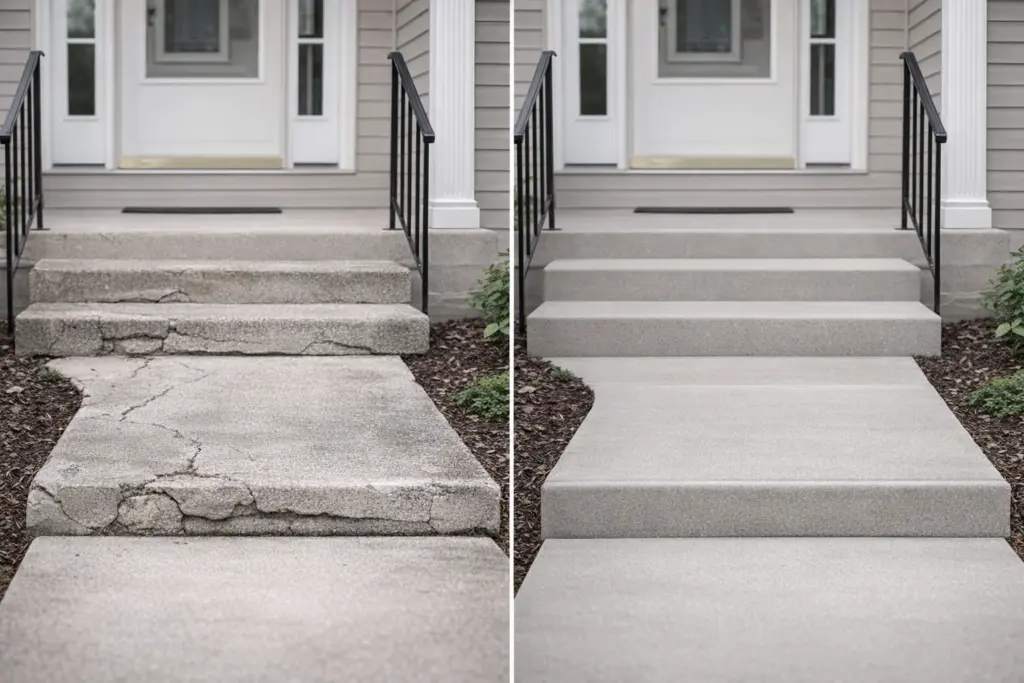
Paths and steps are the smallest work we take on and the most often poured alongside something else. The published New Zealand minimum for a path is 75 mm. We pour 100 mm as standard, because a path that a wheelbarrow, a trailer or a ride-on ever crosses is not carrying foot traffic alone.

Steps get formed to consistent risers. Tell us at the visit if the path connects to a driveway, because the two usually pour on the same day.

Sunken concrete slab levelled in Hamilton

Patio Replacement and Resurfacing

On a tired patio we start by telling you whether the slab underneath is worth keeping. Where the base is sound and the panels sit level, resurfacing over the top is a real option and it is a fraction of the disruption.

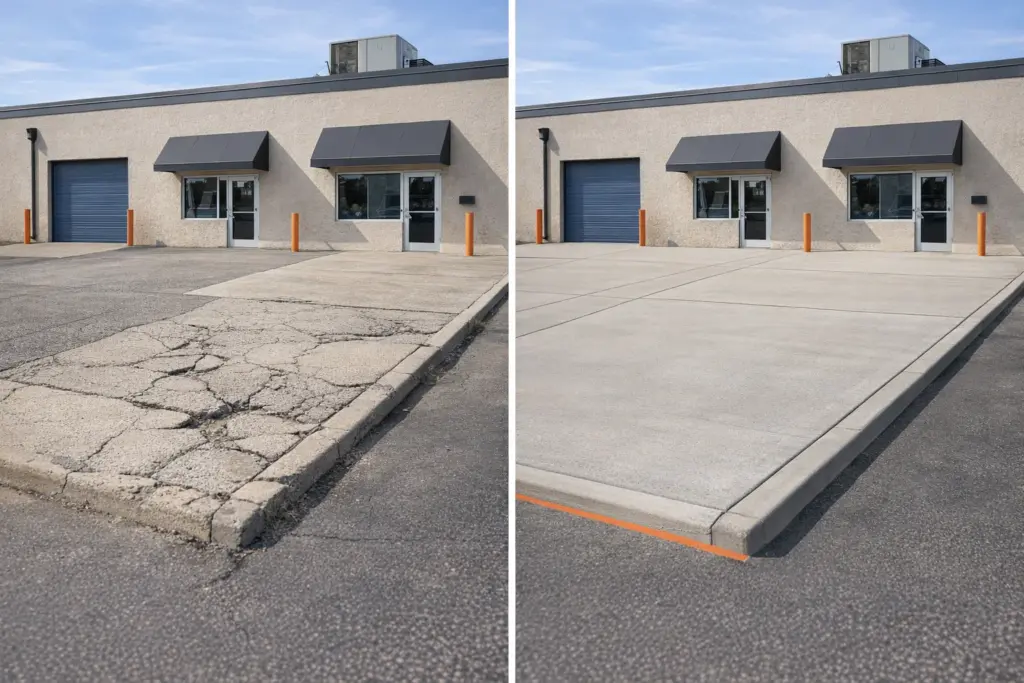
Where panels have stepped, or the slab sits too high against the cladding, a resurface makes both problems worse. That one comes out and goes back down at the right level.

The Build

How We Build a Concrete Patio

Five steps from the first site visit to the day the furniture goes back on.

01

Patio Site Assessment and Levels

We measure the area, take the levels off the house, and check what height the finished surface can come to against your cladding. The visit costs nothing and nothing gets booked off the back of it.

02

Written Quote and Finish Selection

The price comes back in writing with the finish, the slab thickness, the base and the joint layout set out. You pick the finish off that before any concrete is ordered.

03

Cladding Clearance and Stormwater Check

Two things get settled here. The clearance from the finished surface to your cladding, and where the water goes. Over 20 square metres of new paved area, Hamilton has a stormwater rule that applies and we allow for it.

04

Base, Boxing and Mesh

We dig out, cart the spoil away and compact the base in layers. Boxing goes to the setout with the falls already built into it, then mesh up on chairs so the steel sits inside the slab.

05

Pour, Cut and Seven Day Cure

We pour, screed and draw the broom across the fall. Joints get cut at 4 metre centres to a quarter of the slab depth, inside 24 hours of the pour. The slab is then kept moist for seven days, which is what keeps efflorescence off the finish.

Garage slab on a compacted base in Hamilton
5.0

Rated on Google

Concrete Patio Prices in Hamilton

A concrete patio in Hamilton runs between $110 and $210 per square metre laid, and the finish decides where in that band you land. Plain and broom finish sits at $110 to $160. Coloured concrete runs $130 to $180. Exposed aggregate starts around $140 and goes past $200 where the stone is a feature.

Paths and footpaths sit a little under a patio at $100 to $150. Replacing an existing patio costs more than pouring on bare ground, at $130 to $190, because the old slab has to come out and go somewhere.

These figures are a guide and not a quote. Every patio is measured on site before it is priced, and the quote comes to you in writing.

Patio workGuide range
Plain or broom finish patio$110 to $160 / m²
Coloured concrete patio$130 to $180 / m²
Exposed aggregate patio$140 to $210 / m²
Concrete paths and footpaths$100 to $150 / m²
Patio replacement, including break-out$130 to $190 / m²

What Moves the Price of Your Patio

Finish choice. A broom finish sits at the bottom of the band. Colour adds oxide through the mix. Exposed aggregate adds the stone, the wash and the extra hands on pour day, which is what puts it at the top.

Levels against the house. A finished surface that has to sit lower than the existing ground means digging out and carting away before anything is formed. That is set by the clearance to your cladding and it is not negotiable.

Stormwater. New paved area over 20 square metres brings Hamilton’s retention rule into play, and meeting it can mean a soakage pit, a rain garden or permeable paving in part of the area.

Shape and edges. Formwork governs the labour on a patio more than it does on a driveway. A rectangle off the back of the house is quick. Curves, planter returns, steps and level changes are not.

Steps and retaining. Where a patio has to hold a level change, the step or the wall is a separate piece of work with its own reinforcement.

Site access. Getting concrete to a back yard is the part people underestimate. Where a truck cannot reach the area the pour needs a pump or barrowing, and that changes the hours.

Base and ground. Fill, soft ground and old garden beds all need work before a patio goes over them. The base decides whether the slab is still flat in ten years.

Sealing. Exposed aggregate and stamped work are usually sealed. Plain and broom are often left alone.

Why Us

Why Hamilton Homeowners Pick Us for a Patio

Six things that separate a patio that lasts from one that has to come out. Most of them are settled before the boxing goes in.

We Check the Clearance to Your Cladding First

A patio poured too high against the house is the most expensive mistake on this kind of job. The floor level has to sit 150 mm above a permanently paved surface where the cladding is weatherboard, fibre cement or plaster, and 100 mm where it is brick veneer. We take that measurement before we quote.

Falls Set at 1 in 40 Away From the House

Water has to leave a patio, and it has to leave it away from the building. We set the fall at 1 in 40, which is 25 mm of drop for every metre. On a smooth accurately finished surface 1 in 50 will do it, and anything flatter than that ponds.

Control Joints Cut at 4 Metre Centres

Joints go in at 4 metre centres on a 100 mm slab, cut to a quarter of the slab depth inside 24 hours of the pour. Shrinkage has to go somewhere. A joint is the difference between a straight line you chose and a crack across the middle of your outdoor area.

Seven Day Moist Cure Against Efflorescence

The white bloom people see on new concrete is efflorescence, and moist curing for seven days is what reduces it. It works by making the surface denser and less permeable. Skipping the cure to get off site quicker is what puts it there.

Hamilton’s 20 Square Metre Stormwater Rule Allowed For

Hamilton requires retention of at least 10 mm of runoff depth on new impermeable surfaces over 20 square metres. Most patios are bigger than that. We raise it at the site visit so it is in the plan and the price from the start.

Broom Texture Drawn Across the Fall

The broom gets drawn across the fall, not along it. That puts the texture at right angles to the way water runs, which is where the grip is needed. A stiff broom gives deeper texture for a wet area, a soft broom a finer finish under cover.

Coloured concrete patio in Hamilton
Clearances and Stormwater

Two Hamilton Rules That Change a Patio

A patio poured by a Hamilton concreting crew that works to the Code answers to two rules a driveway never meets. Both are settled before the boxing goes in, and both are expensive to fix afterwards.

The clearance to your cladding. A patio raises the ground level against the house, and the Building Code sets how close that surface can come to the bottom of the wall. For cladding other than masonry veneer the floor level has to sit 150 mm above a permanently paved surface, or 225 mm above unpaved ground. For masonry veneer the figures are 100 mm and 150 mm.

Most Hamilton houses are weatherboard, fibre cement or plaster, so 150 mm is the number that applies, and the 100 mm figure people quote is the brick one. Get it wrong and the consequences are the ones BRANZ lists: splash onto absorbent cladding, water moving by capillary action, paint failing early, then rot in timber and corrosion in fixings. These are Acceptable Solutions, so building outside them is not automatically a breach. It does mean the work leaves the deemed-to-comply path and has to be justified another way, which is not a conversation worth having over a patio.

Hamilton’s stormwater rule. Under the operative District Plan, development of new impermeable surfaces greater than 20 square metres in a residential zone must provide retention of at least 10 mm of runoff depth on that new area. A patio of any real size clears 20 square metres, so the rule applies to most of them.

There is a way through it that most people do not know about. The rule excludes porous and permeable paving from the definition of impermeable surfaces. Where part of an area is built permeable to Council’s practice note, which sets a minimum 200 mm basecourse at a void ratio of at least 30 per cent, that part stops counting. Council states that meeting the practice note means neither a building consent nor specific engineering design is required for the permeable section.

The other half of a Hamilton patio is the ground under it, and it is the same story as everywhere else in this city. Old garden beds, fill and soft ground all move at different rates. We dig them out rather than pour over them.

Reviews

Hamilton Patio Reviews

Every review below is a Google review left by a customer, pulled live from our profile.

EXCELLENT
Google star 1Google star 2Google star 3Google star 4Google star 5
Based on 10 reviews
Posted on Google Google
Amit Sharma profile picture
Amit Sharma
Google star 1Google star 2Google star 3Google star 4Google star 5Trustindex verifies that the original source of the review is Google.
My driveway was cracked all over and needed replacement as it was very old and worn off. I called Hamilton Concrete Contractors for a quote and consultation. Olly came over the next day to have a look and suggested the solution that best suited to my driveway's condition. I really liked the friendly vibes from Olly and he sounded like he genuinly cared. I got 3 more quotes from other companies but they were very transactional in my opinion. I liked Olly's approach and vibe so decidied to go ahead with him. He did an exceptional job for me and I am happy with the service.
Posted on Google Google
kritika arora profile picture
kritika arora
Google star 1Google star 2Google star 3Google star 4Google star 5Trustindex verifies that the original source of the review is Google.
We had an outstanding experience with Hamilton Concrete Contractors. The team was professional, punctual, and highly skilled. They handled our concrete project from start to finish with great precision, ensuring a smooth and durable finish. Their attention to detail and quality workmanship was excellent, and they kept the site clean and safe throughout the process. Communication was clear and consistent, and all our questions were answered promptly. We are extremely happy with the results and highly recommend Hamilton Concrete Contractors for any residential or commercial concrete work in Hamilton.
Posted on Google Google
Seyi Oluokun profile picture
Seyi Oluokun
Google star 1Google star 2Google star 3Google star 4Google star 5Trustindex verifies that the original source of the review is Google.
Tested and trusted. They have proven that they are reliable for any construction project. Highly recommended to all and sundry.
Posted on Google Google
abah boniface profile picture
abah boniface
Google star 1Google star 2Google star 3Google star 4Google star 5Trustindex verifies that the original source of the review is Google.
They are absolutely reliable, they kept to the agreement and they delivered the job smoothly
Posted on Google Google
Damilola Oscar (J Hanameel) profile picture
Damilola Oscar (J Hanameel)
Google star 1Google star 2Google star 3Google star 4Google star 5Trustindex verifies that the original source of the review is Google.
One of the best at this. I am very excited to work with them. You can trust them too, I strongly recommend!
Verified by Trustindex
Trustindex verified badge is the Universal Symbol of Trust. Only the greatest companies can get the verified badge who has a review score above 4.5, based on customer reviews over the past 12 months. Read more
Common Questions

Concrete Patio FAQs

The questions people ask before booking a patio, answered here so you do not have to ring for them.

Between $110 and $210 per square metre laid, and the finish decides where you land. A broom finish sits at $110 to $160, coloured concrete runs $130 to $180, and exposed aggregate starts near $140 and can pass $200. Paths run $100 to $150. Replacing an existing patio including break-out is $130 to $190. Every patio is measured on site before it is priced.

Lower than most people expect. Where the cladding is weatherboard, fibre cement or plaster, the floor level has to sit 150 mm above a permanently paved surface, or 225 mm above unpaved ground. Where it is brick veneer, the figures are 100 mm and 150 mm. The 100 mm number gets quoted as though it covers everything, and on most Hamilton houses it does not. We take that measurement at the site visit.

Over 20 square metres of new paved area, yes. The District Plan requires retention of at least 10 mm of runoff depth on new impermeable surfaces above that size in residential zones. Porous and permeable paving is excluded from the definition, so building part of the area permeable is one way to meet it. A soakage pit or a rain garden are others. We raise it at the site visit so it is priced in.

A patio at ground level is not covered either way in the Government’s exempt building work guidance, so check your specific job with Hamilton City Council. What is clear is the deck threshold. Building work on a deck or platform does not need a consent as long as it is not possible to fall more than 1.5 metres from the surface. Once a patio is raised past that, it is a different job.

We pour 100 mm as standard. The published New Zealand minimum for a path is 75 mm, and there is no patio-specific figure in the standards at all. We use 100 mm because a patio carries furniture, spas and the occasional wheel, and because it gives the joints enough depth to work. Steel goes in on chairs so it sits inside the slab.

A day or two for careful foot traffic, and keep off the edges and corners because they gain strength last. The slab is kept moist for seven days while it cures. Concrete gains strength fastest in the first week and then keeps going. The 28-day figure people quote is the age a mix is usually tested against its specified compressive strength, not the point it stops hardening. Leave heavy furniture and a spa until the month is up.

That is efflorescence, a white deposit that forms as salts move to the surface. It does not weaken the concrete. Moist curing for seven days reduces it by making the surface denser and less permeable, which is one of the reasons we cure rather than walking off site. Where it does appear, stiff brushing or a dilute acid wash lifts it.

All of Hamilton City. We lay patios on the tight new sections through Rototuna and Flagstaff, where outdoor space is at a premium, and on the bigger established back yards in Hillcrest and Glenview. Cambridge and Te Awamutu as well. Anything further out gets quoted on the size of the job and the access to the back of the section.

Free Patio Quotes

Get a Free Concrete Patio Quote

Tell us the rough size of the area and the finish you are after. We come out, measure it and send the price in writing. Call 07 808 6940.

Request Your Patio Quote
