

Concrete Paths and Footpaths Hamilton

At Hamilton Concrete Contractors we pour concrete paths and footpaths across Hamilton and the Waikato, on entry paths, side paths, garden walkways, right of ways, steps and ramps. A path is the smallest concrete job most people ever buy and it is the one they walk on every single day, so the things that matter are the fall, the finish and the joints.

We pour paths at 100 millimetres, which is above the 75 millimetre minimum published for a path in New Zealand, and we set the fall at about 1 in 40 so water leaves the surface. The path to your front door is an access route under the Building Code and it has to hold grip when wet. We measure the route, set the levels against the house and put the price in writing.

Quick. Reliable. Local.
Google Reviews five star rating
Miss QQ
Verified Google Review

“I highly recommend Hamilton Concrete Contractors. They are a reliable company that does top-notch work.

Get Your Free Concrete Path Quote

Tell us roughly how long the path is and how wide you want it. If it runs beside the house, let us know the cladding type, because that sets how low the finished path has to sit.

★★★★★
5.0 on Google | 10+ years in the trade
Paths and Steps

Concrete Path Work We Take On

Six kinds of path work cover nearly everything we quote. Entry and side paths bring in the most jobs and steps carry the most detail per metre, so those two lead. Paths rarely arrive on their own, and most go in alongside the other concrete we are already pouring on the section.

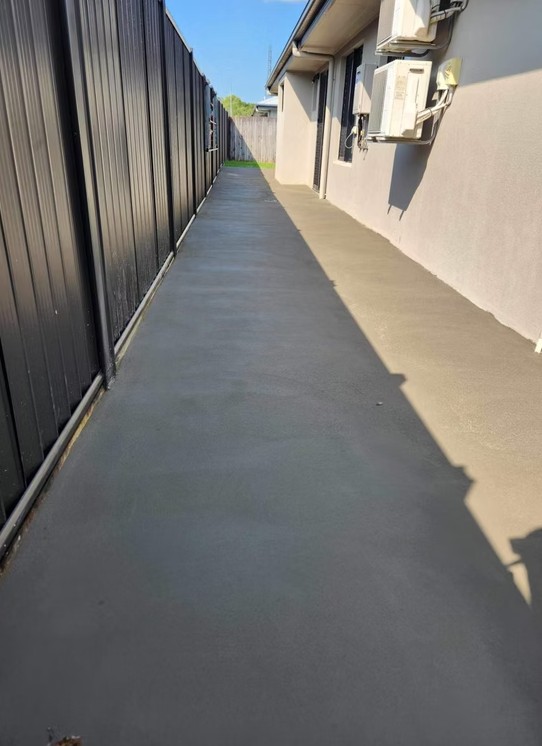
Concrete path laid in Hamilton

Concrete Paths and Walkways

Entry paths and side paths are the work we do most of, and the fall is the decision that makes or breaks one long after the finish has stopped mattering.

A path with no fall holds water, and water sitting on concrete grows moss and makes a surface slippery through a Waikato winter. We set a cross fall so the water leaves, and we take it away from the house rather than towards it, which sounds obvious and is the single most common fault we are called to correct.

Concrete footpath poured in Hamilton

Footpaths and Right of Way Paths

Footpaths and shared right of way paths are the jobs where we deal with more than one property owner, and the levels have to work for all of them.

These runs are longer, they often cross boundaries, and they usually have services buried under them. We locate what is down there before excavating, since a path is shallow work and a shallow strike is still a strike. Widths get set so two people can pass.

Stamped concrete path and steps in Hamilton

Concrete Steps and Landings

Steps are the most detailed concrete we pour per square metre, and they are also the element where getting it slightly wrong is felt every single day.

Consistent riser heights matter more than anything else, because a set of steps where one riser differs from the others is what catches people out. We form risers and treads to a set out rather than to the slope of the ground, and each tread gets a slight fall so water clears the nosing.

Non slip concrete finish in Hamilton

Accessible Routes and Ramps

Ramps and accessible routes are the paths we build to the tightest set out, because the gradient, the landings and the surface all have to work together for someone using a wheelchair or a walker.

A ramp that is slightly too steep is genuinely unusable. We set the gradient, build in level landings where the run is long, and use a finish with grip that holds when the surface is wet.

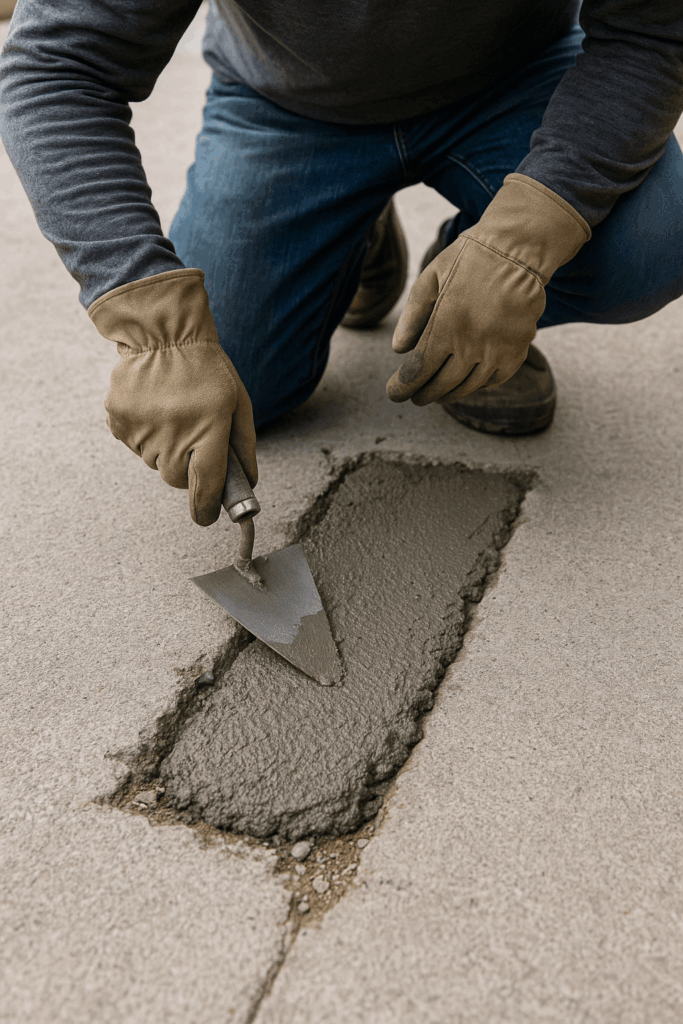
Concrete surface repaired in Hamilton

Path Replacement and Tree Root Damage

Lifted and cracked paths come to us as trip hazards, and on a mature Hamilton section the cause is nearly always a tree root under the slab.

Replacing the panel without dealing with the root gets you the same lift again in a few years. We look at what is growing nearby, deal with the root where it can be dealt with, and where the tree has to stay we can form the path around it or specify a thicker panel over a root barrier.

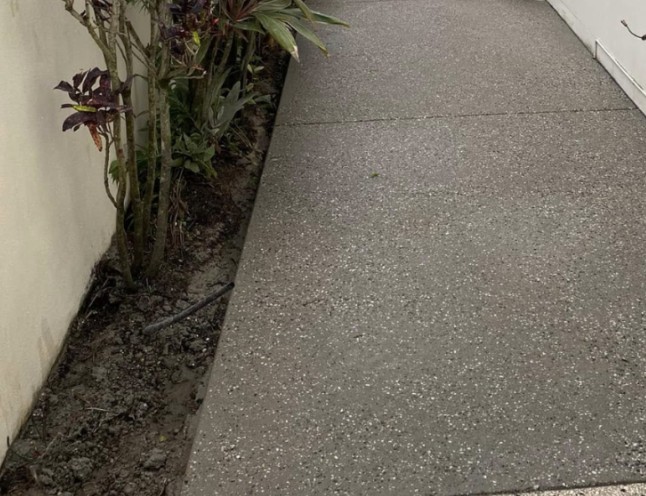
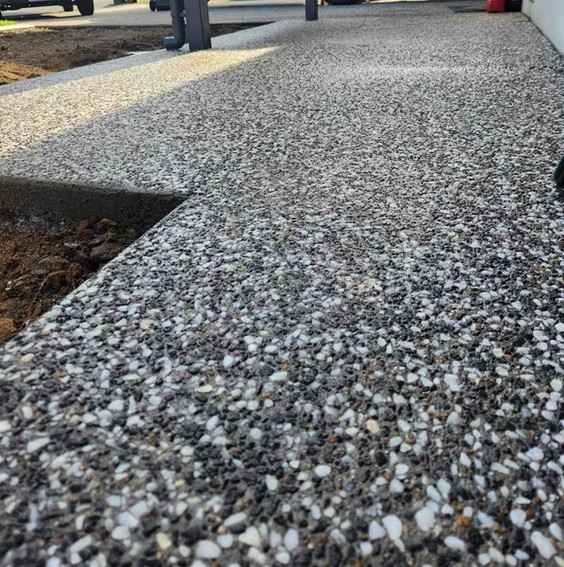
Exposed aggregate concrete finish in Hamilton

Non Slip Finishes for Wet Areas

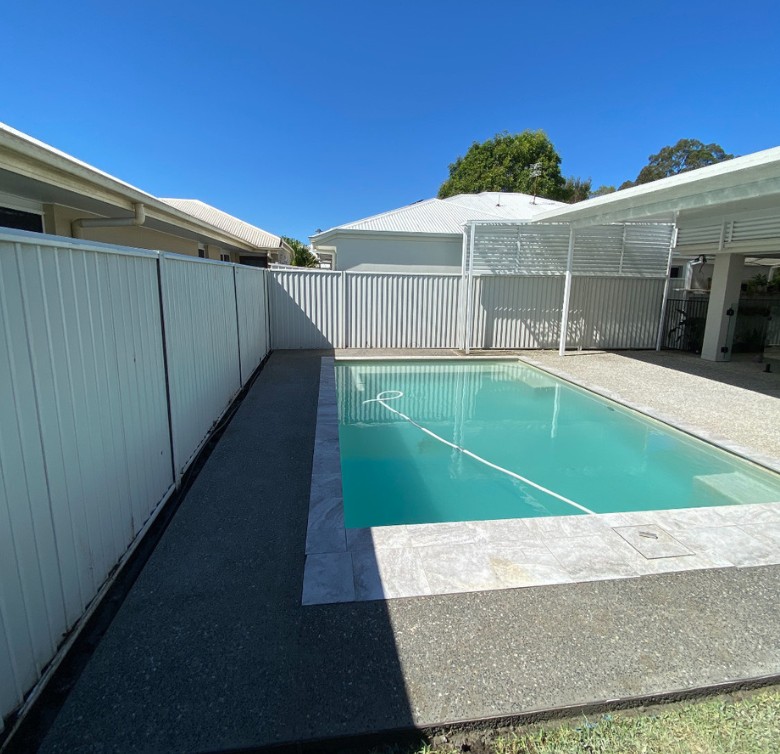
Non slip finishes are what we specify around pools, on ramps and on any path that sits in permanent shade, since those are the surfaces that actually catch people.

A stiff broom leaves a deeper texture than a soft one. Exposed aggregate puts the grip in the concrete itself. We match the texture to how wet the surface gets and how steep it runs, and we do that before the pour.

Route and Fall

How We Form and Pour a Concrete Path

Five stages, and the fall is decided in the first one.

01

Route, Levels and Fall Set Out

We peg the route, take levels off the house and the ground, and set the fall. Where the path runs beside the building the finished level is set from the cladding down, not from the ground up.

02

Written Quote and Path Specification

The quote names the width, the thickness, the finish, the joint spacing and where the water goes. Buried services are identified at this stage.

03

Excavation, Base and Edge Forms

We excavate to depth, compact the base and set edge forms to the pegged line and level. Curves are formed with flexible boards so the edge runs true.

04

Pour and Broom Across the Fall

Concrete is placed, screeded and floated, then broomed across the direction of the fall so the texture runs at right angles to the way water travels.

05

Joint Cut, Cure and Reinstatement

Control joints are cut at 4 metre centres to a quarter of the slab depth within 24 hours, the path is damp cured for seven days, and edges are backfilled and reinstated.

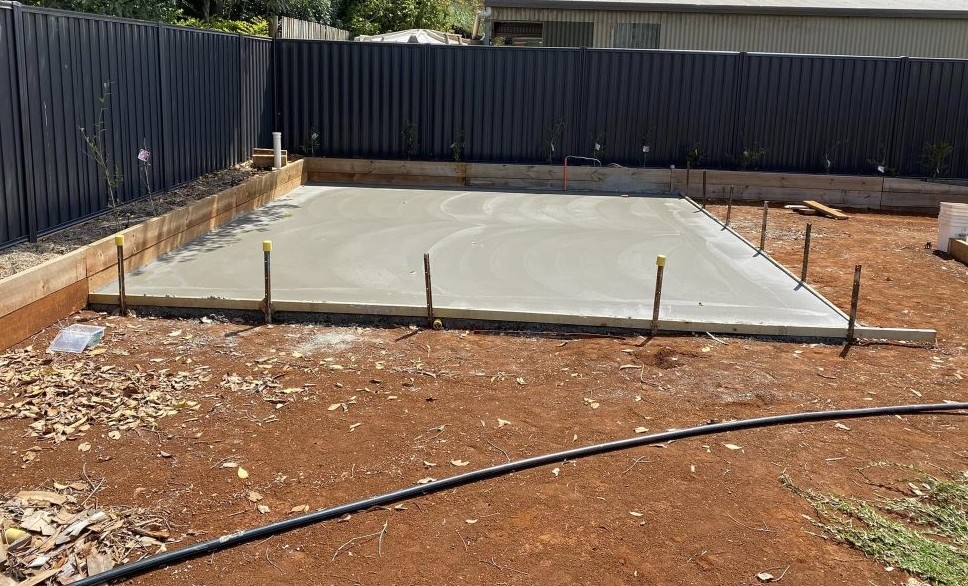
Concrete patio laid in Hamilton
5.0

Rated on Google

Concrete Path Prices in Hamilton

Concrete paths and footpaths in Hamilton run $100 to $150 per square metre laid. A straight run in an open section sits at the bottom of that band. Narrow paths, curves, steps and areas a truck cannot reach sit at the top, because formwork and barrowing are what the hours go into on small work.

Steps are quoted separately from the path they connect, since a formed riser and tread is considerably more work per square metre than a flat run. Exposed aggregate and coloured finishes on a path run $140 to $210 and $120 to $170 per square metre respectively.

Guide ranges as at August 2026, and not a quote. We walk the route with you on site, set the levels and the price comes back in writing.

Concrete path workGuide range (Aug 2026)
Concrete paths and footpaths, broom finish$100 to $150 / m²
Coloured concrete path$120 to $170 / m²
Exposed aggregate path$140 to $210 / m²
Formed steps and landingsQuoted per flight

What Moves the Price of a Concrete Path

Width and length. A path is mostly edge. A narrow path has nearly as much formwork per square metre as a wide one has in total, so width changes the rate as much as the area does.

Curves and changes of direction. Straight runs form quickly with straight boards. Curves need flexible forms, more pegs and more time to get a true line.

Steps and level changes. Formed risers and treads are the most labour intensive concrete on a residential section, and each one has to be set out.

Access for the pour. A truck that can reach the path is the cheapest outcome. Barrowing concrete down the side of a house adds hours, and on many paths it is unavoidable.

Finish. Broom is the standard. Exposed aggregate and coloured finishes add materials and time on the day.

Excavation and what comes out. Shallow work, but the spoil still leaves on a truck, and paths beside houses often run through established garden.

Tree roots and existing surfaces. Breaking out an old path, and dealing with whatever lifted it, before anything new goes down.

Drainage. Where a path crosses the line water already takes, a channel drain or a soak pit becomes part of the job.

How We Build

What Separates a Path That Lasts

Six things that decide whether a path is still level, dry and safe to walk on in fifteen years.

One Hundred Millimetres Where Seventy Five Is the Published Minimum

The published minimum thickness for a concrete path in New Zealand is 75 millimetres. We pour at 100. The extra 25 millimetres is a small part of the cost of a path and it is the difference between a slab that tolerates a wheelbarrow, a mower and a tree root and one that cracks the first time something heavy crosses it.

Fall Set at One in Forty Away From the House

A fall of about 1 in 40, which is 25 millimetres for every metre of width, takes water off a path. On a smooth, accurately finished surface 1 in 50 is acceptable. The direction matters as much as the number, and it always runs away from the building.

Broom Drawn Across the Fall

The broom gets drawn across the direction of the fall, not along it. Texture running the same way as the water gives it channels to follow and does nothing for grip underfoot. Across the fall, the texture interrupts the flow and gives a foot something to hold. It takes no extra time and almost nobody does it.

Joints at Four Metre Centres on a Path

A path is not a driveway and it does not take driveway joint spacing. On a 100 millimetre path, control joints go in at 4 metre centres, cut to a quarter of the slab depth within 24 hours. Spacing them like a driveway leaves panels long enough to crack in the middle.

Clearance Held Below the Cladding Line

Where a path runs beside the house, the finished level is set from the cladding down. Weatherboard, fibre cement and plaster want 150 millimetres between the bottom of the cladding and a paved surface. A path poured to the existing ground level instead is how a dry wall becomes a damp one.

We Deal With the Roots Before We Pour

On an established section the thing that lifted the old path will lift the new one. We look at what is growing nearby before quoting, deal with the root where that is possible, and where the tree stays we form around it or build over a root barrier. Pouring over a live root and saying nothing is the cheap option and it fails.
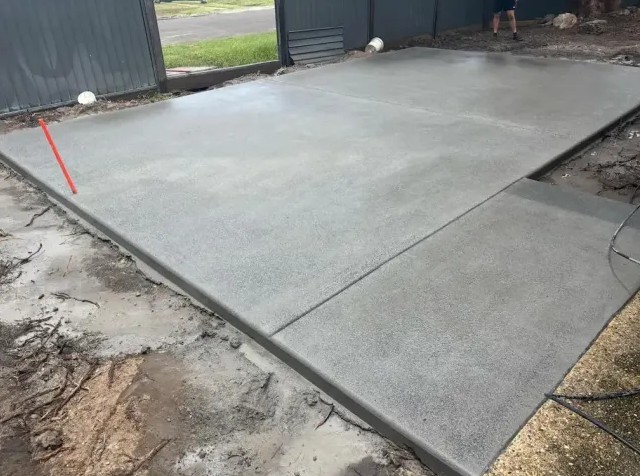
Concrete patio in Hamilton
Access and Stormwater

Paths, Access Routes and the Hamilton Stormwater Rule

Two rules apply to a path in Hamilton that most people never hear about, and both of them are worth knowing before the forms go in.

The first is that the path to your front door is not just a path. Building Code clause D1.3.3(d) requires access routes to have adequate slip resistant walking surfaces under all conditions of normal use, and the guidance is explicit that walking surfaces on the approaches to main building entrances are included. That is why the finish on an entry path is a specification. Where a level access route is used by the public, the acceptable solution sets a coefficient of friction of at least 0.4.1. A private path to a house is not held to that figure, and it is a useful benchmark for what an adequate surface actually means.

The second is stormwater, and it catches people because a path feels too small to trigger anything. Under the Hamilton District Plan, development of new impermeable surfaces greater than 20 square metres in area in the residential zones must implement stormwater management measures, including retention of at least 10 millimetres of runoff depth on the new surface. A path on its own is often under that threshold. A path poured in the same job as a patio or a widened driveway frequently is not, because it is the total new impermeable area that counts. Permeable paving is excluded from the definition of impermeable surface under that rule, which is the usual way through it.

Under the path, the Hamilton story is the same as everywhere else in this city. Council geotechnical work describes the Hinuera Formation as interbedded coarse alluvium, pumice gravels, peat and silts, and as highly variable both laterally and vertically. Add a mature tree and its roots and you have the two things that lift paths here. Hamilton City grew 8.6 per cent between the 2018 and 2023 censuses, and the paths we are replacing now mostly went in long before that.

Reviews

Google Reviews From Hamilton Concrete Customers

Reviews left by our customers on Google, showing live from the profile.

EXCELLENT
Google star 1Google star 2Google star 3Google star 4Google star 5
Based on 10 reviews
Posted on Google Google
Amit Sharma profile picture
Amit Sharma
Google star 1Google star 2Google star 3Google star 4Google star 5Trustindex verifies that the original source of the review is Google.
My driveway was cracked all over and needed replacement as it was very old and worn off. I called Hamilton Concrete Contractors for a quote and consultation. Olly came over the next day to have a look and suggested the solution that best suited to my driveway's condition. I really liked the friendly vibes from Olly and he sounded like he genuinly cared. I got 3 more quotes from other companies but they were very transactional in my opinion. I liked Olly's approach and vibe so decidied to go ahead with him. He did an exceptional job for me and I am happy with the service.
Posted on Google Google
kritika arora profile picture
kritika arora
Google star 1Google star 2Google star 3Google star 4Google star 5Trustindex verifies that the original source of the review is Google.
We had an outstanding experience with Hamilton Concrete Contractors. The team was professional, punctual, and highly skilled. They handled our concrete project from start to finish with great precision, ensuring a smooth and durable finish. Their attention to detail and quality workmanship was excellent, and they kept the site clean and safe throughout the process. Communication was clear and consistent, and all our questions were answered promptly. We are extremely happy with the results and highly recommend Hamilton Concrete Contractors for any residential or commercial concrete work in Hamilton.
Posted on Google Google
Seyi Oluokun profile picture
Seyi Oluokun
Google star 1Google star 2Google star 3Google star 4Google star 5Trustindex verifies that the original source of the review is Google.
Tested and trusted. They have proven that they are reliable for any construction project. Highly recommended to all and sundry.
Posted on Google Google
abah boniface profile picture
abah boniface
Google star 1Google star 2Google star 3Google star 4Google star 5Trustindex verifies that the original source of the review is Google.
They are absolutely reliable, they kept to the agreement and they delivered the job smoothly
Posted on Google Google
Damilola Oscar (J Hanameel) profile picture
Damilola Oscar (J Hanameel)
Google star 1Google star 2Google star 3Google star 4Google star 5Trustindex verifies that the original source of the review is Google.
One of the best at this. I am very excited to work with them. You can trust them too, I strongly recommend!
Verified by Trustindex
Trustindex verified badge is the Universal Symbol of Trust. Only the greatest companies can get the verified badge who has a review score above 4.5, based on customer reviews over the past 12 months. Read more
Before You Set the Route

Concrete Path FAQs

What people ask before we peg out a route.

$100 to $150 per square metre laid. A straight run in an open section sits at the bottom of that band, and narrow paths, curves and areas a truck cannot reach sit at the top, because formwork and barrowing take the hours on small work. Steps are quoted separately since a formed riser and tread is much more work per square metre. Exposed aggregate runs $140 to $210 and coloured runs $120 to $170. Guide ranges, quoted in writing.

The published minimum for a path in New Zealand is 75 millimetres. We pour at 100. The extra 25 millimetres costs very little on a path and it is what lets the slab take a wheelbarrow, a ride on mower or a root pushing up underneath without cracking. Anyone telling you 100 millimetres is a code minimum for a path is wrong, and being straight about that is worth more than the sale.

About 1 in 40, which is 25 millimetres for every metre of width. A smooth, accurately finished surface can go to 1 in 50. Direction matters as much as the number, and it always runs away from the building. A path with no fall holds water, and standing water grows moss and makes the surface slippery through winter. It is the most common fault we are called out to correct.

Not a building consent for the path itself. There is a district plan rule worth knowing about though. Development of new impermeable surfaces greater than 20 square metres in the residential zones has to implement stormwater management measures, including retention of at least 10 millimetres of runoff on the new surface. A path alone is often under that. A path poured with a patio or a wider driveway often is not, because the total new area counts.

Almost always a tree root. On established Hamilton sections roots grow under shallow paths and push a panel up over years, which is what creates the trip edge. Replacing the panel without dealing with the root produces the same lift again. We look at what is growing nearby, deal with the root where that is possible, and where the tree has to stay we form around it or build over a root barrier.

Texture, applied across the direction of the fall. A stiff broom leaves a deeper non slip texture than a soft one. Exposed aggregate gives grip that comes out of the concrete rather than off a coating that wears. Shade is usually the real problem, since a path that never dries grows moss whatever the finish, so we look at fall and drainage before texture.

As close as you like, but the level is set by the cladding rather than by the ground. The requirement is 150 millimetres from the bottom of weatherboard, fibre cement or plaster cladding down to a paved surface, and 100 millimetres for masonry veneer. Pouring a path to the existing ground level beside a house is how a dry wall becomes a damp one, so we take that measurement before we set the forms.

Foot traffic after a day or two, staying off the edges and corners while they are green. The path is damp cured for seven days from the pour. A wheelbarrow, a mower or anything with a wheel and a load should wait the full seven days, and ten through a Hamilton winter, since concrete sets and gains strength more slowly in the cold. Full strength is 28 days.

Free Path Quotes

Get a Free Concrete Path Quote

Tell us the rough size of the area and the finish you are after. We come out, measure it and send the price in writing. Call 07 808 6940.

Request Your Concrete Path Quote
